MATH 1 · CHAPTER 3
THE STRAIGHT LINE
Slope · Parallel & Perpendicular · Distance · Forms of Lines
GROUP 4 — Leoder · Nagaño · Sarmiento · Mojica · Taño · Peñano · De Vera
OUR JOURNEY
Four stops, one line
1
SLOPE OF A LINE
how steep is it?
2
PARALLEL & PERPENDICULAR
how lines relate
3
DISTANCE FROM A POINT TO A LINE
the shortest path
4
FORMS OF LINES
one line, five ways to write it
+
AREA OF A TRIANGLE
application: area from coordinates alone
Then: a 10-point quiz — posted tomorrow, answered within the day.
SECTION 1 · SLOPE OF A LINE
Slope = rise over run
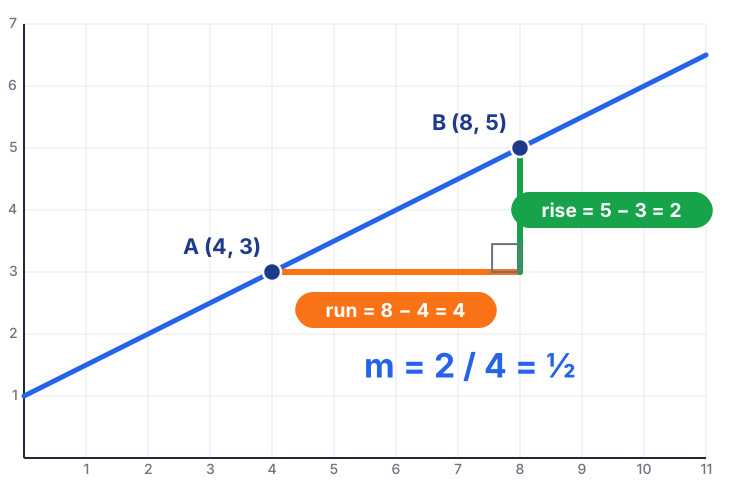
m = ( y₂ − y₁ ) / ( x₂ − x₁ )
m = 2 / 4 = 1/2
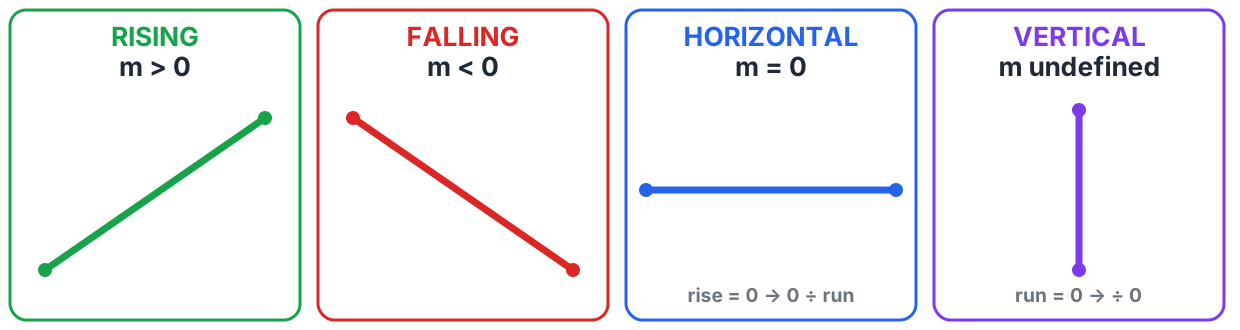
positive → the line RISES
SECTION 1 · WORKED EXAMPLE
Watch the steps
Points
A (4, 3) and B (8, 5)
Subtract the y's
5 − 3 = 2 → the RISE
Subtract the x's
8 − 4 = 4 → the RUN
Same order matters: whichever point is “first” on top must be first at the bottom.
SECTION 1 · READING A LINE AT A GLANCE
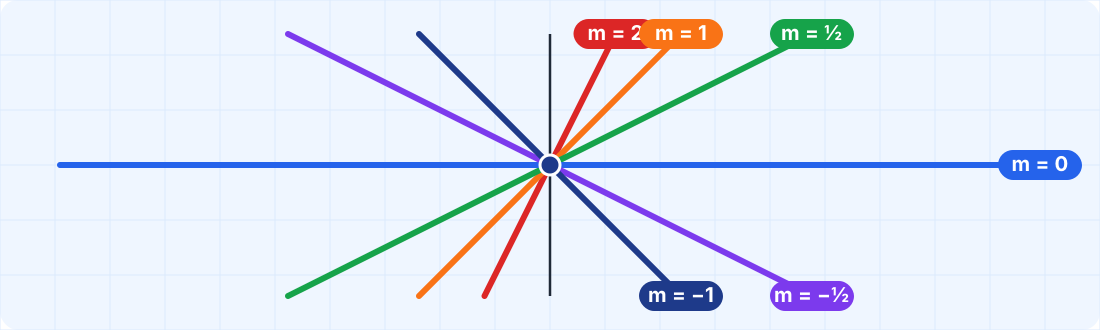
The four faces of slope
Vertical line: the run is 0 — dividing by zero is impossible, so the slope is UNDEFINED.
Horizontal line: the rise is 0 — so the slope is exactly 0.
LIVE · LINE LAB
Drag the points — watch the line
Rise / run
Slope m
Angle θ
y = mx + b
General form
⊥ slope
Try: make a vertical line · a horizontal line · two points with slope −1.
SECTION 1 · ANGLE OF INCLINATION
Slope is a tangent
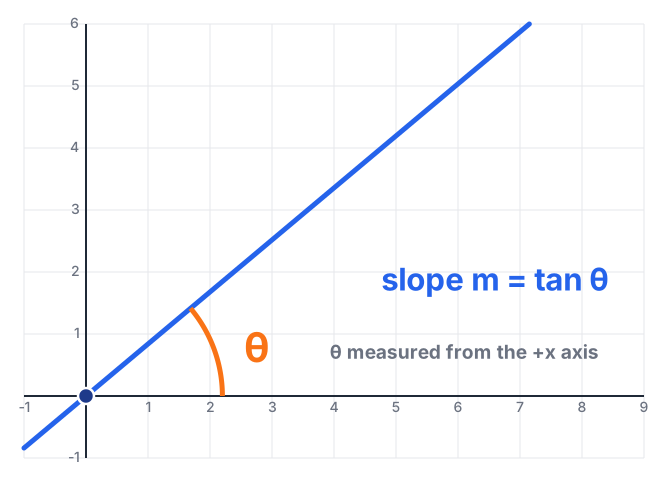
θ = smallest positive angle from the +x axis
m = tan θ
θ acute → m positive
θ obtuse → m negative
θ = 90° → undefined
SECTION 2 · PARALLEL LINES
Parallel: same steepness, never meet
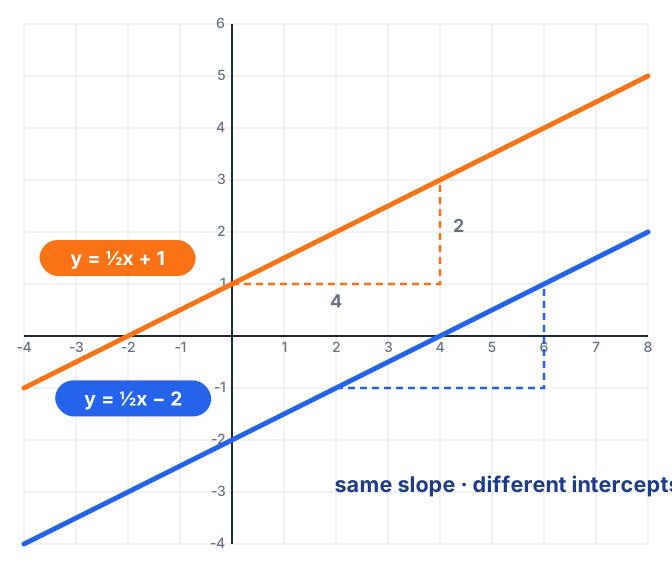
m₁ = m₂
AND different y-intercepts
Same slope + same intercept
= the SAME line, not parallel
SECTION 2 · PERPENDICULAR LINES
Perpendicular: slopes multiply to −1
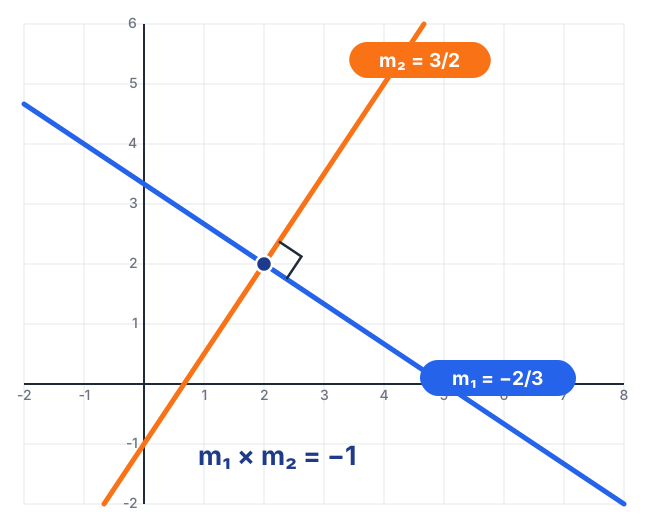
m₁ × m₂ = −1
(−2/3) × (3/2) = −1 ✓
Flip the fraction, flip the sign:
−2/3 → 3/2
SECTION 2 · COLLINEAR POINTS
Three points, one line?
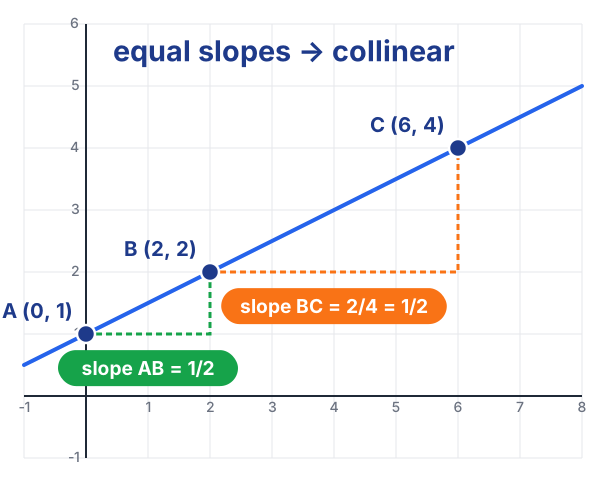
slope AB = slope BC
→ A, B, C are COLLINEAR
Close is not enough — the slopes must be EQUAL.
(Bonus test: area = 0)
SECTION 3 · DISTANCE FROM A POINT TO A LINE
Distance = the shortest path
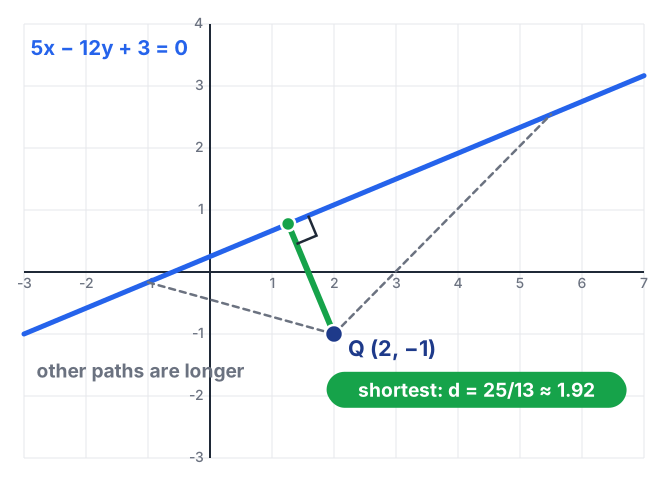
The shortest path from a point to a line is always the PERPENDICULAR one — 90°.
Any other path is longer.
Signed distance also tells you WHICH SIDE of the line you're on.
SECTION 3 · THE FORMULA AT WORK
One line, three points
d = | A x₀ + B y₀ + C | / √( A² + B² ) · for the line Ax + By + C = 0
Line: 5x − 12y + 3 = 0 → √(5² + 12²) = √169 = 13
P (−2, 1)
| −10 − 12 + 3 | / 13 = 19/13 ≈ 1.46
Q (2, −1)
| 10 + 12 + 3 | / 13 = 25/13 ≈ 1.92
R (5, 0)
| 25 − 0 + 3 | / 13 = 28/13 ≈ 2.15
The absolute value is there because distance is never negative.
SECTION 4 · FORMS OF LINES
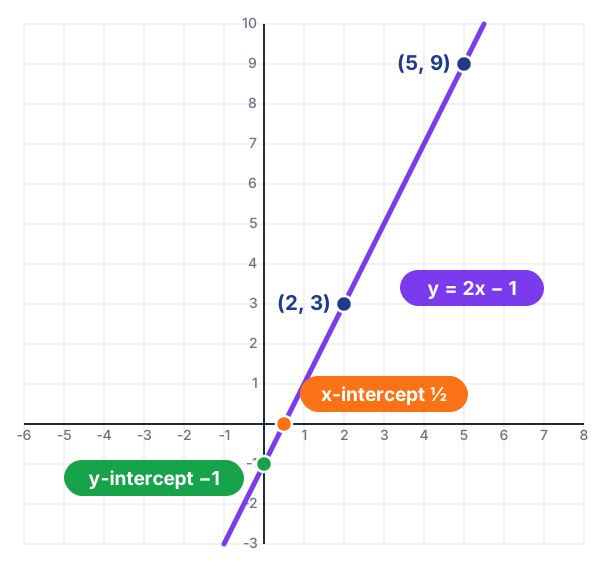
One line, five ways to write it
SECTION 4 · CHOOSING THE FORM
Match the form to the givens
| Two points given | TWO-POINT FORM | through (2, 3) and (5, 9) → y = 2x − 1 |
| Slope + one point | POINT-SLOPE FORM | m = 2 through (3, 4) → y = 2x − 2 |
| Slope + y-intercept | SLOPE-INTERCEPT | m = −2, b = 5 → y = −2x + 5 |
| Both intercepts | INTERCEPT FORM | 2x + 5y = 20 → x/10 + y/4 = 1 |
| Final / standard answer | GENERAL FORM | y = (2/3)x + 1 → 2x − 3y + 3 = 0 |
Intercept form fails for lines through the origin — one intercept would be 0.
APPLICATION · AREA OF A TRIANGLE
Area from coordinates alone
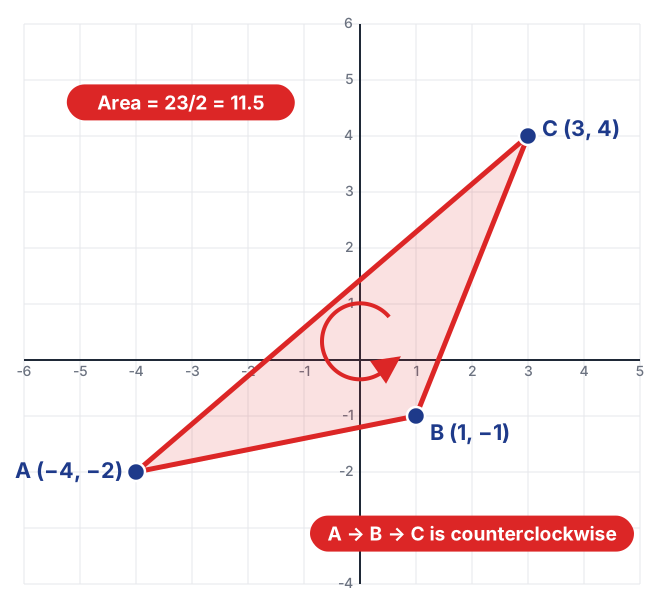
No base. No height.
Just the three vertices — and one determinant.
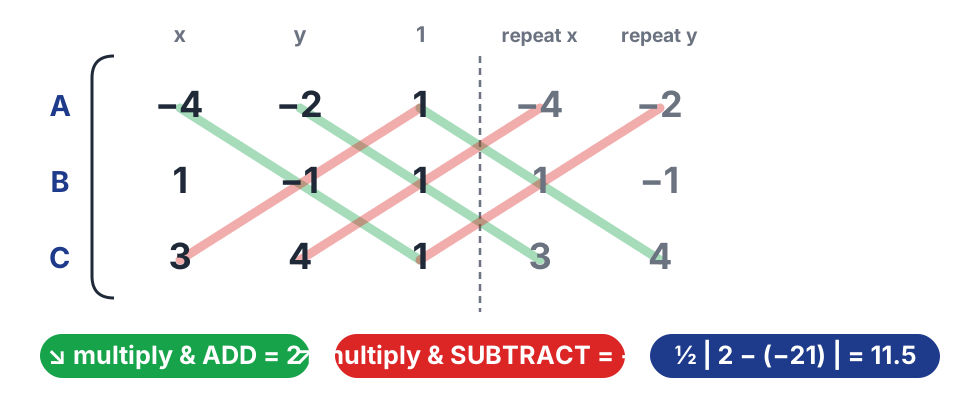
First: list the vertices COUNTERCLOCKWISE.
Order decides the sign.
APPLICATION · THE DETERMINANT WEAVE
Copy, weave, halve
Down (add)
(−4)(−1) + (−2)(3) + (1)(4) → 4 − 6 + 4 = 2
Up (subtract)
(3)(−1) + (4)(−4) + (1)(−2) → −3 − 16 − 2 = −21
Halve the difference
Area = ½ | 2 − (−21) | = 23/2 = 11.5 square units
60-SECOND CHECK
Say these out loud
1
Slope = rise / run = tan θ. Vertical: undefined. Horizontal: 0.
2
Parallel: equal slopes, different intercepts. Perpendicular: product = −1.
3
Distance = |Ax₀ + By₀ + C| / √(A² + B²) — absolute value, always positive.
4
Five forms — pick by the givens. Triangle area: weave the determinant, then halve.
YOUR TURN
The Group 4 Quiz
10 POINTS
6 objective questions + 2 computation questions (2 pts each)
Google Forms — posted tomorrow, answered within the day
Reporters are exempt from their own quiz.
THANK YOU!
Questions?
GROUP 4 · MATH 1 · CHAPTER 3 — THE STRAIGHT LINE
WATCH & REVIEW
See it again, slower
Every formula in this deck is worked step by step on the Lessons page.