The Straight Line — Lessons
Every formula from the presentation, worked step by step. Use this page to study before the quiz.
▶ Open the presentation Try the Line Lab
Slope of a line
Slope measures steepness: how far the line goes up (rise) for every step across (run).
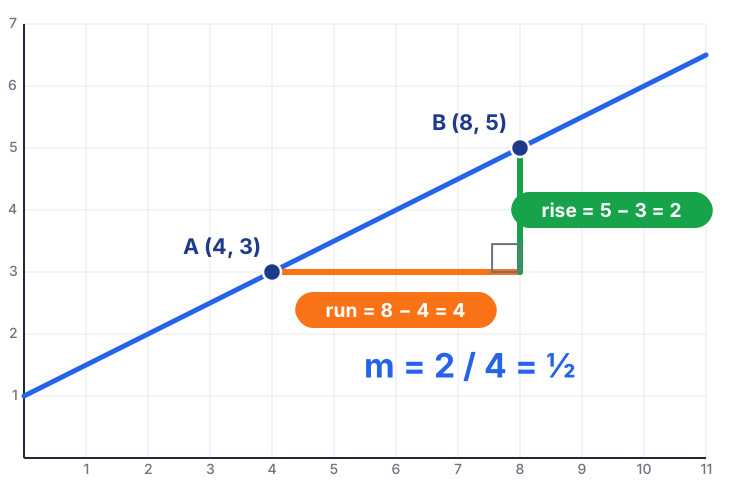
The four faces of slope
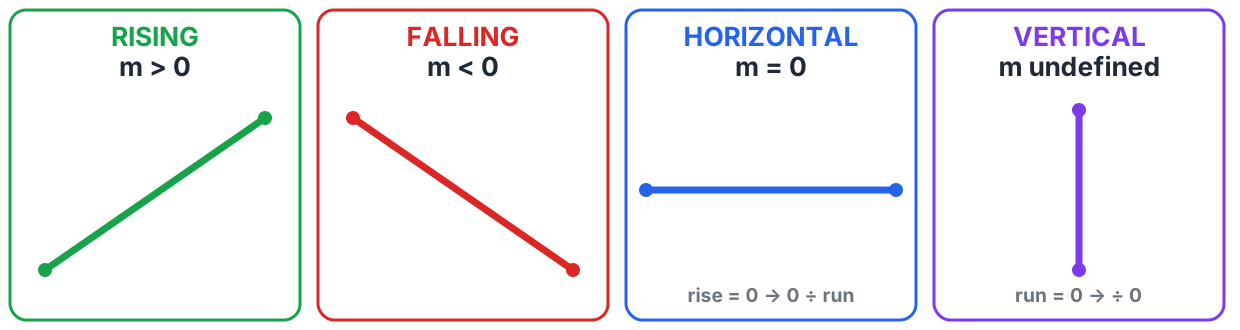
| Line | Slope | Why |
|---|---|---|
| Rising (↗) | m > 0 | rise and run have the same sign |
| Falling (↘) | m < 0 | rise and run have opposite signs |
| Horizontal | m = 0 | rise = 0 |
| Vertical | undefined | run = 0, and dividing by zero is impossible |
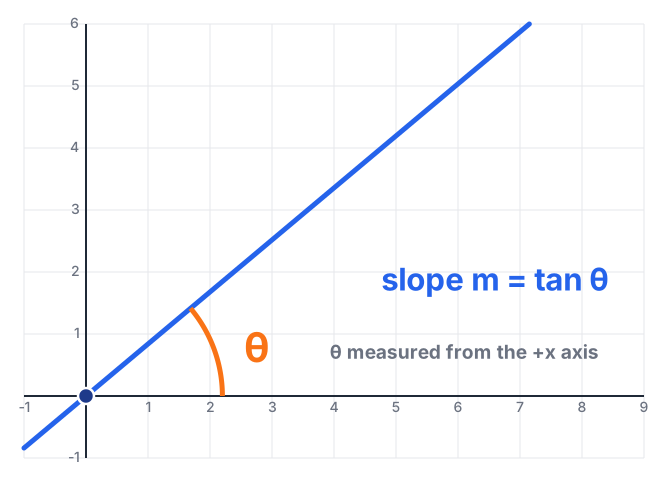
Angle of inclination
θ is the angle from the +x axis to the line (0° ≤ θ < 180°), and m = tan θ. Acute θ → positive slope; obtuse θ → negative slope; θ = 90° → undefined.
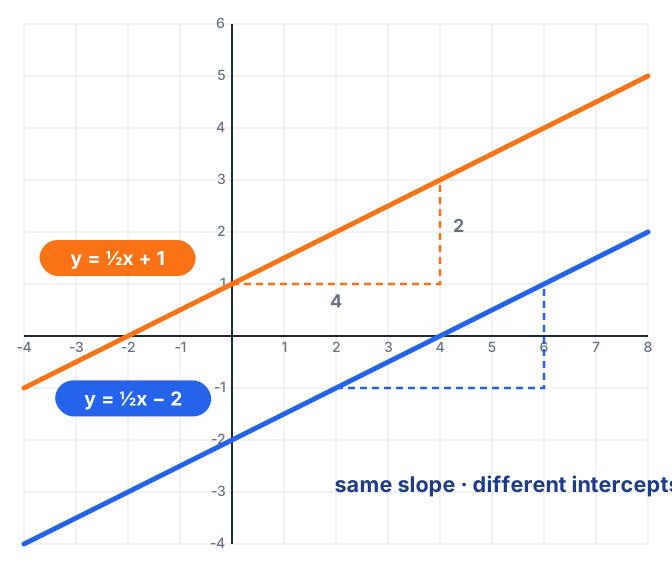
Parallel & perpendicular lines
Perpendicular: m₁ · m₂ = −1
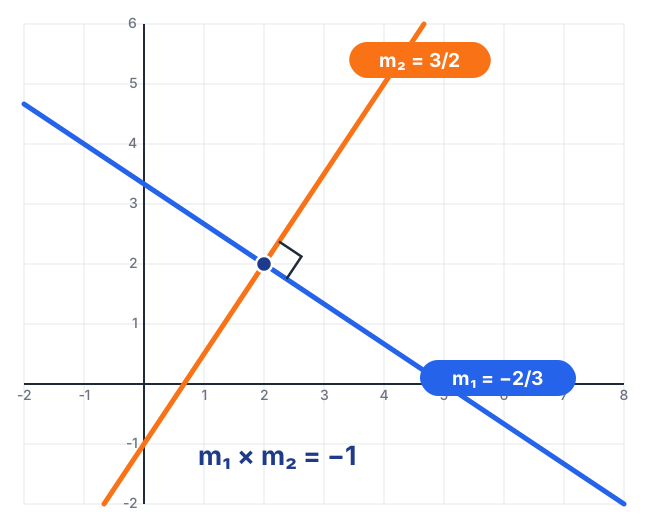
To get a perpendicular slope: flip the fraction and change the sign. −2/3 → 3/2, and (−2/3)(3/2) = −1 ✓.
Collinear points
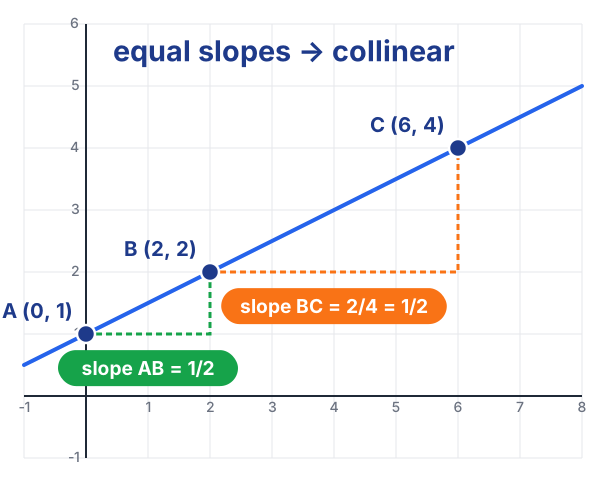
Three points are on one line when the slope between the first two equals the slope between the last two.
Distance from a point to a line
The shortest path from a point to a line is the perpendicular one.
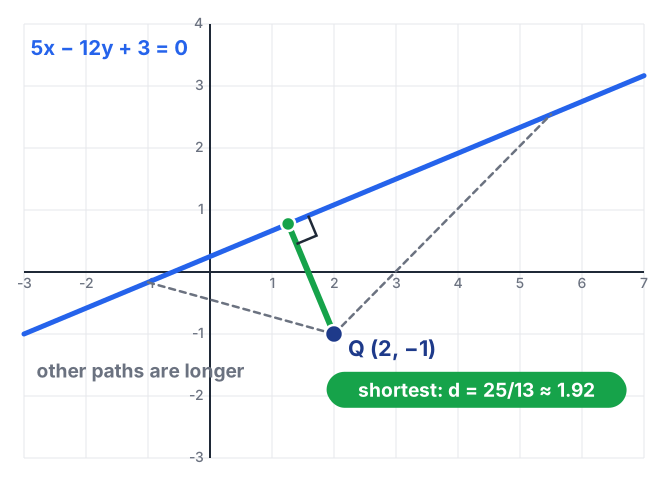
Steps: (1) write the line in general form, (2) substitute the point, (3) take the absolute value, (4) divide by √(A² + B²).
- P (−2, 1): |−10 − 12 + 3| / 13 = 19/13 ≈ 1.46
- Q (2, −1): |10 + 12 + 3| / 13 = 25/13 ≈ 1.92
- R (5, 0): |25 − 0 + 3| / 13 = 28/13 ≈ 2.15
Forms of lines
| Form | Equation | Use when you are given… |
|---|---|---|
| Two-point | y − y₁ = [(y₂ − y₁)/(x₂ − x₁)] (x − x₁) | two points |
| Point-slope | y − y₁ = m (x − x₁) | slope and one point |
| Slope-intercept | y = m x + b | slope and y-intercept |
| Intercept | x/a + y/b = 1 | both intercepts |
| General | A x + B y + C = 0 | the standard final answer |
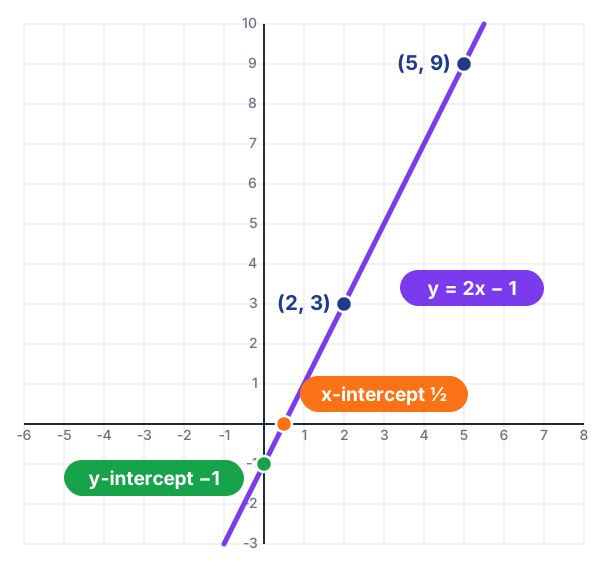
- Through (2, 3) and (5, 9): m = 6/3 = 2 → y − 3 = 2(x − 2) → y = 2x − 1
- m = 2 through (3, 4): y − 4 = 2(x − 3) → y = 2x − 2
- m = −2, b = 5: y = −2x + 5
- 2x + 5y = 20: divide by 20 → x/10 + y/4 = 1 (intercepts 10 and 4)
- y = (2/3)x + 1: multiply by 3 → 3y = 2x + 3 → 2x − 3y + 3 = 0
Area of a triangle from coordinates
No base, no height — only the three vertices. List them counterclockwise so the determinant comes out positive.
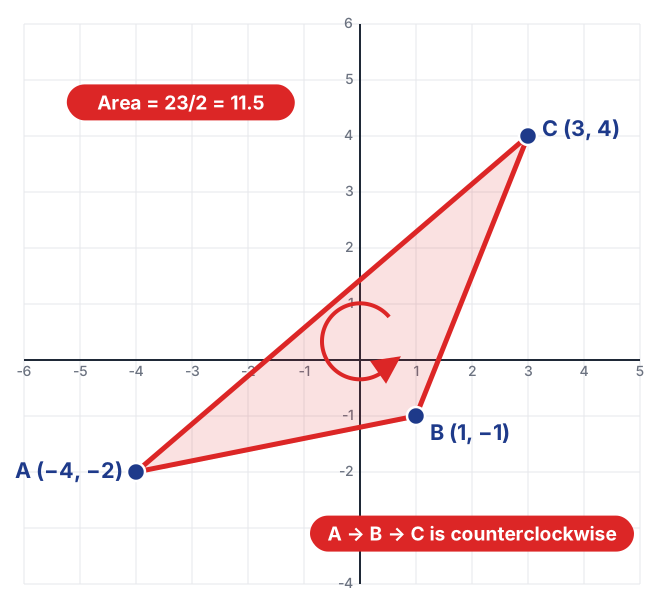
The “weave” is the same computation drawn as a diagram: copy the first two columns to the right, add the ↘ diagonals, subtract the ↗ diagonals, then halve.
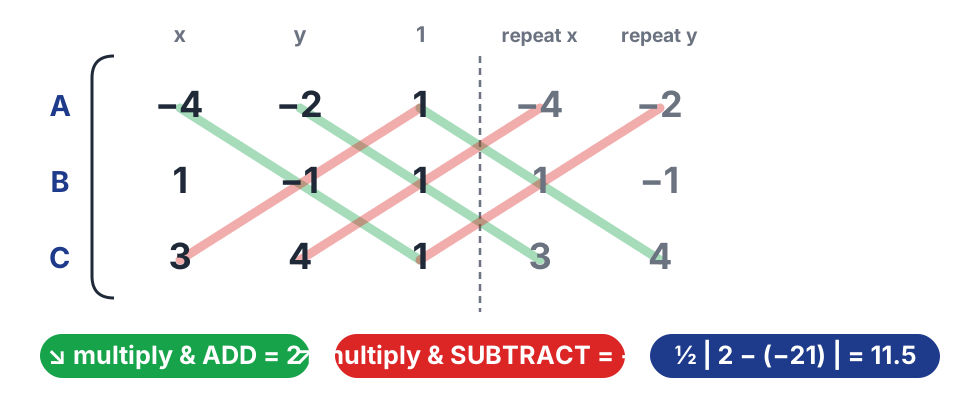
- ↘ (add): (−4)(−1) + (1)(4) + (3)(−2) = 4 + 4 − 6 = 2
- ↗ (subtract): (3)(−1) + (−4)(4) + (1)(−2) = −3 − 16 − 2 = −21
- Area = ½ | 2 − (−21) | = 23/2 = 11.5 square units